
www.auto-innovations.net
10
'26
Written on Modified on
MG Advances Hybrid and Driver Assistance Technologies
MG has presented its next-generation Plug-in Hybrid+, battery and driver assistance technologies for future electrified mobility in Europe.
www.mg.co.uk
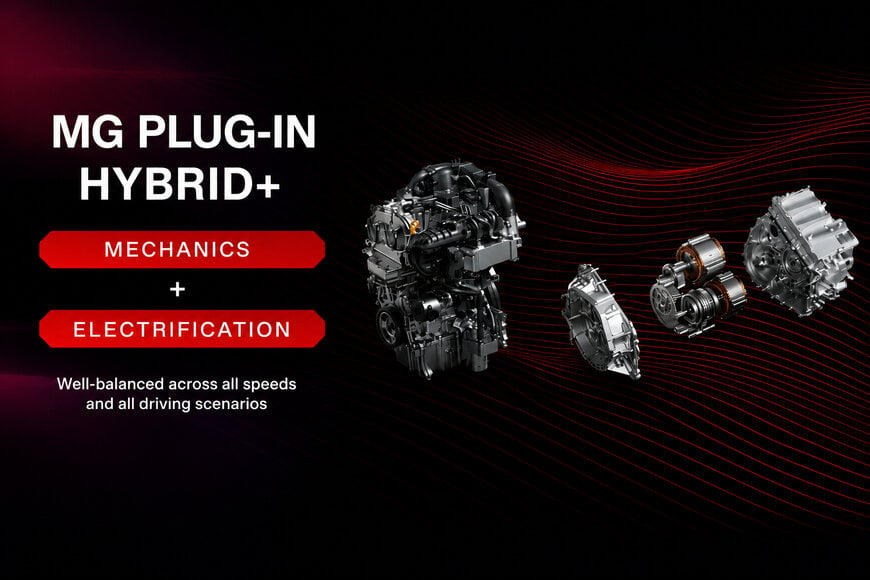
MG has introduced a new technology roadmap combining next-generation plug-in hybrid powertrains, semi-solid-state battery technology and advanced driver assistance systems (ADAS). The developments target passenger vehicles across multiple SUV segments and support the company's long-term strategy for electrification, intelligent mobility and autonomous driving.
Plug-in hybrid system improves efficiency and performance
Presented during MG Tech Day at the company's UK headquarters in London on 8 July 2026, the new Plug-in Hybrid+ platform combines dedicated hybrid engines, a redesigned transmission and intelligent energy management. The first production model using the new system, the MG ZS Plug-in Hybrid+, is scheduled for launch in 2027.
The system is available with newly developed 1.1-litre and 1.5-litre turbocharged petrol engines designed specifically for hybrid applications. According to MG, the engines achieve thermal efficiencies exceeding 42% and 43%, respectively.
The hybrid transmission combines Power Split and Motor Decoupling technologies. Power Split continuously distributes torque between the internal combustion engine and electric motors to optimise energy use under varying driving conditions. Motor Decoupling disconnects the generator during pure electric driving, reducing mechanical drag and improving electric drive efficiency.
The control system automatically switches between electric drive at low speeds, hybrid power split at medium speeds and direct engine drive at higher speeds. MG states that the engine maintains thermal efficiency above 40% during approximately 90% of operating conditions while electric drive efficiency reaches up to 90%.
Performance figures include acceleration from 0 to 62 mph in less than six seconds and 50 to 75 mph acceleration in as little as 3.5 seconds. The company also reports up to a 72% improvement in hill-start capability. Generator decoupling reduces noise, vibration and harshness by up to 5 dB during electric operation compared with conventional plug-in hybrid systems.
Semi-solid-state battery technology for hybrid vehicles
MG confirmed that its SolidCore Battery technology will be integrated into future Plug-in Hybrid+ models. The semi-solid-state battery architecture uses a 3D spinel structure intended to improve energy conversion efficiency, power response and operational stability.
The battery is designed to provide more consistent power output across varying vehicle speeds, driving conditions and ambient temperatures. According to MG, the technology reduces performance degradation caused by low battery charge or cold weather, improving driving consistency throughout the vehicle's operating range.
The first Plug-in Hybrid+ vehicles equipped with SolidCore Battery technology will be three new SUVs in the B, C and D segments.
ADAS development based on European driving conditions
MG is expanding its advanced driver assistance systems using real-world driving data collected across Europe. More than 1.2 million kilometres of driving data from 24 European countries have been used to refine software algorithms for local traffic conditions, including roundabouts, tram crossings, shared road spaces and complex urban layouts.
The company's One Touch iAD parking assistance system supports more than 30 parking scenarios and over 300 parking space types, including unmarked parking areas.
Available functions include automatic parking space detection, kerbside parking assistance, automated exit manoeuvres from confined spaces and reverse path memory capable of retracing up to 100 metres while monitoring for obstacles. The system also incorporates 360-degree camera guidance, trajectory visualisation and automatic braking when pedestrians or cyclists are detected.
MG stated that future versions will introduce head-in parking, remote parking assistance, smartphone-based straight-line vehicle control and personalised parking preferences.
Navigate On Autopilot extends motorway assistance
MG is developing Navigate On Autopilot (NOA) as the next stage of its MG Pilot driver assistance platform. The system is scheduled to debut in a new MG SUV in late 2027.
Highway NOA is designed for supervised motorway driving and will assist with motorway entry and exit, lane selection, lane changing and overtaking. The driver remains responsible for vehicle control throughout operation.
Urban NOA is under development for more complex traffic environments involving pedestrians, cyclists, traffic lights and intersections, with deployment expected from 2028 following additional validation.
Autonomous mobility research continues
MG is also conducting Level 4 Robotaxi trials in Germany, China and the Middle East. Level 4 autonomous vehicles are capable of operating without driver intervention within predefined operational domains.
The company stated that testing continues to validate the technology before any decision is made regarding future production vehicle deployment.
Context for electrified mobility
The technologies announced by MG combine improvements in hybrid powertrain efficiency, battery performance and intelligent driving systems. Together, these developments support the wider adoption of electrified vehicles while addressing operational efficiency, driver assistance and future autonomous mobility applications.
Additional context:This section details technical specifications and competitive benchmarking not included in the original product announcement
The semi-solid-state battery sector is becoming a major development area within the automotive industry. Unlike conventional lithium-ion batteries, semi-solid-state batteries replace part of the liquid electrolyte with solid materials, improving thermal stability and reducing performance losses at low temperatures. MG states that its SolidCore Battery uses approximately 95% solid electrolyte, representing an intermediate step before fully solid-state battery technology.
Several automotive manufacturers are pursuing similar technologies. Toyota, Mercedes-Benz, Stellantis and Honda are developing solid-state battery platforms, although most remain in prototype or demonstration phases. MG differentiates its approach by introducing semi-solid-state batteries into series production, while competitors continue validating full solid-state systems for later commercial deployment. Industry benchmarks for comparison include energy density, charging speed, cold-weather performance, thermal stability and production scalability.
Edited by Sucithra Mani, Induportals editor – adapted by AI.
www.mg.com
