
www.auto-innovations.net
11
'26
Written on Modified on
Cellcentric NextGen Heavy-Duty Fuel Cell System
Designed for Class 8 trucks, the cellcentric NextGen fuel cell system reduces weight and complexity to optimize long-haul heavy-duty transport.
www.cellcentric.net
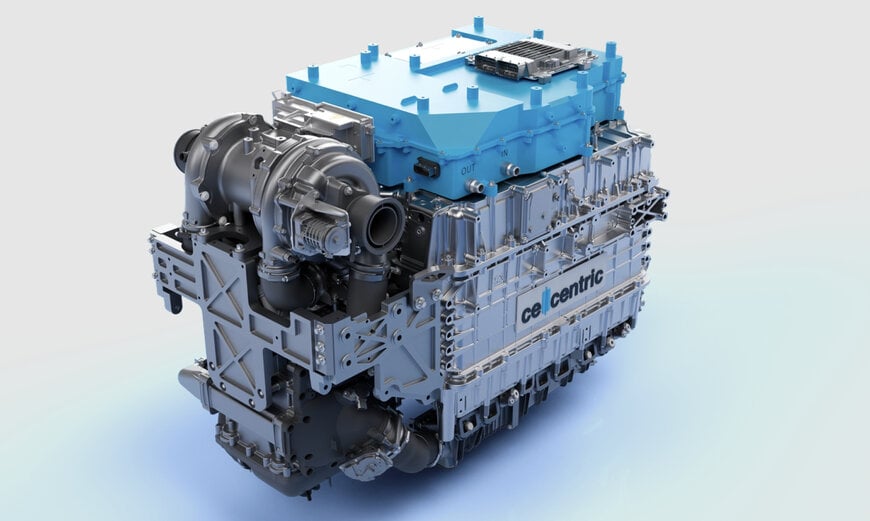
Fleet operators face the engineering challenge of decarbonizing long-haul logistics without sacrificing payload capacity or driving range. To address this operational requirement, cellcentric has introduced its NextGen fuel cell system, a high-power hydrogen solution specifically engineered for integration into standard heavy-duty vehicle platforms.
Engineering Context
The transition to zero-emission drive systems in long-haul heavy-duty transport requires alternatives that match the operational flexibility of conventional diesel engines. Battery-electric systems often introduce payload penalties due to heavy battery packs and require extended charging times on long routes. Hydrogen fuel cell systems address these industrial needs by offering continuous power generation on board, combining high payload capacities with rapid refueling times. To maintain a competitive Total Cost of Ownership (TCO), fuel cell systems must deliver high energy conversion efficiency while minimizing thermal management requirements.
Technical Explanation and Operating Principle
The NextGen fuel cell system generates up to 375 kW (over 500 horsepower) of continuous net power by converting hydrogen and oxygen into electricity, with water vapor and heat as the only byproducts. The system achieves a 20 percent reduction in hydrogen consumption compared to the previous BZA150 generation through three primary engineering mechanisms. First, the active area of the fuel cell stack has been increased. Second, the system utilizes an improved Membrane Electrode Assembly (MEA) incorporating new catalyst formulations to optimize the electrochemical reaction. Third, system parameters, such as cathode pressure, have been refined to maximize cell technology benefits. Furthermore, the architecture allows for higher operating temperatures, resulting in a 40 percent reduction in waste heat at 300 kW net power, which directly decreases the cooling requirements of the vehicle chassis.
Product Relevance and Technical Specifications
Packaged as a single unit, the NextGen system weighs approximately 400 kilograms and is dimensionally engineered to fit into conventional 13-liter diesel engine compartments, facilitating integration for truck manufacturers. The system operates with 40 percent less complexity and a 40 percent higher power density than its predecessor. In a real-world application, a fully loaded 40-ton heavy-duty truck utilizing this system is projected to consume approximately 9.7 kilograms of hydrogen per 100 miles, equating to 10.2 miles per kilogram of hydrogen. These parameters allow Class 8 trucks to achieve operational ranges exceeding 650 miles, depending on the storage capacity of compressed gas (over 700 bar) or liquid hydrogen (LH2).
Real-World Applications and Industrial Integration
The technology was detailed to the industry at the ACT Expo 2025 in Anaheim, California, from April 28 to 30, 2025. The NextGen system builds upon the operational framework of cellcentric's BZA150 generation, which has undergone rigorous testing by shareholders Daimler Truck AG and Volvo Group. Previous integration testing included high-altitude evaluations at the Brenner Pass, as well as extreme winter testing at the Simplon Pass and the Arctic Circle. A notable baseline was established in 2023 when a Mercedes-Benz GenH2 Truck, powered by twin BZA150 fuel cells, covered 1,047 kilometers on public roads utilizing 80 kilograms of liquid hydrogen. Current pilot production of fuel cell systems is situated near Stuttgart, Germany. To support wide-scale industrialization, the NextGen system is slated for large-scale manufacturing at the planned KLIMA|WERK facility in Weilheim by the end of the decade.
Additional Context
This section details technical specifications and competitive benchmarking not included in the original product announcement.
Within the commercial vehicle sector, hydrogen fuel cell technology is increasingly recognized as the primary zero-emission benchmark for routes exceeding 500 kilometers. Industry adoption trends indicate a bifurcation in heavy-duty zero-emission transport: battery electric vehicles (BEVs) for regional distribution and predictable point-to-point logistics, and fuel cell electric vehicles (FCEVs) for continuous, high-payload long-haul operations. Regulatory drivers, including the European Union's stringent CO2 emission standards for heavy-duty vehicles and California's Advanced Clean Fleets mandate, are accelerating the shift toward power modules capable of sustaining over 300 kW of continuous net power. The physical packaging of fuel cell systems into the volumetric footprint of legacy 13-liter and 15-liter diesel engines has become an accepted engineering standard to minimize costly chassis redesigns for Original Equipment Manufacturers (OEMs). Furthermore, advancements in modern MEA design focus heavily on reducing platinum group metal (PGM) loadings while enhancing membrane durability to meet the standard commercial vehicle lifespan requirement of 25,000 to 30,000 operating hours.
Edited by Maria Brueva, Induportals editor – adapted by AI.
www.cellcentric.net
