
www.auto-innovations.net
18
'26
Written on Modified on
High-Voltage Connectors for Electric Vehicle Architectures up to 1,200 V
Rosenberger introduced a compact interconnect solution engineered to support high-voltage distribution systems across current and next-generation battery electric vehicle platforms.
www.rosenberger.com
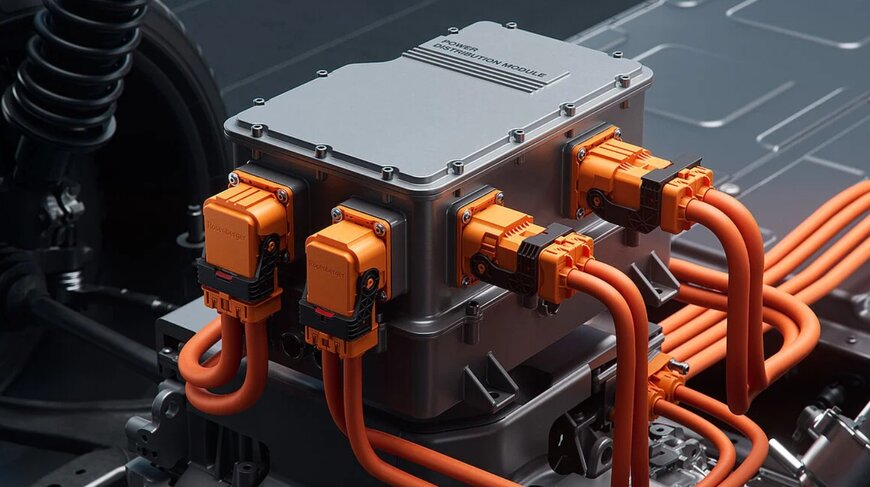
High-voltage powertrain design requires connection interfaces capable of handling elevated potential differences while managing thermal constraints and packaging volumes. Rosenberger developed a single-conductor connection interface rated for operating potentials up to 1,200 V DC, serving automotive electrical distribution systems across 800 V, 1,000 V, and 1,200 V platforms.
Electric Vehicle Powertrain Packaging and High-Voltage Requirements
Automotive electrification continues to transition from 400 V baselines toward 800 V and higher architectures, primarily to minimize resistive losses and allow reduced conductor mass. Higher voltage ratings enable power delivery at reduced continuous current, allowing automotive original equipment manufacturers (OEMs) and harness fabricators to downsize cable cross-sections or substitute conventional copper wiring with aluminum conductors to lower bill-of-materials costs.
The connector handles a continuous current-carrying capacity of 208 A at an ambient temperature of 85 °C, alongside a peak short-time rating of 437 A for up to 100 seconds. Environmental and mechanical durability specifications include an operating temperature envelope of −40 °C to +140 °C and compliance with vibration class V2 per DIN/TS 70214:2025-11 PG 17. The design targets key high-voltage subsystems including traction battery packs, power distribution units (PDUs), traction inverters, and integrated electric axles (eAxles).
Wiring Harness Manufacturing and Automated Assembly Architecture
To address assembly-line cycle times, the system reduces individual piece-part count and features an automation-ready termination profile. Both straight and right-angle cable harness connectors interface directly with a unified header geometry, reducing tooling variance and component inventory for wire harness suppliers.
The system accommodates shielded single-conductor cables with cross-sections of 16 mm², 25 mm², and 35 mm², as well as unshielded variants across 16 mm², 25 mm², 35 mm², and 50 mm². Contact systems are engineered for termination with both copper and aluminum wire cores. Connector security relies on an integrated lever mechanism paired with Connector Position Assurance (CPA), with an optional High Voltage Interlock (HVIL) circuit loop available to verify connection integrity before energization. Manufacturing follows local-for-local supply chain setups and complies with RoHS environmental directives.
According to Thomas Jäkel, Global Sales Director E-Mobility at Rosenberger, the platform aligns with the continuous current and voltage ranges demanded by standard 800 V systems while accommodating subsequent migration toward 1,200 V vehicle electrical architectures.
Additional Context
This section details technical specifications and competitive benchmarking not included in the original product announcement.
Automotive high-voltage interconnect systems operating in the 800 V to 1,000 V+ range typically adhere to standard contact diameter classifications defined by OEM specifications and LV 215 / DIN test frameworks. The Rosenberger interface operates within a contact footprint smaller than classic 8 mm interface terminals, such as the TE Connectivity AMP+ HVA 280 or Amphenol Radsok 5.7 mm systems, while exceeding their voltage ceilings. Standard high-voltage connectors historically maintained maximum continuous voltage isolation thresholds between 750 V and 1,000 V DC, whereas interfaces designed for silicon-carbide (SiC) inverters and 800 V to 1,200 V platforms require extended creepage and clearance distances compliant with DIN/TS 70214. The 437 A short-term surge rating over 100 seconds positions the component alongside dedicated 11 mm contact terminals while using cable cross-sections capped at 35 mm² for shielded configurations.
Edited by Evgeny Churilov, Induportals Media - Adapted by AI.
www.rosenberger.com
