
www.auto-innovations.net
18
'26
Written on Modified on
Fuel Cell System for the BMW iX5
BMW Group implements the third-generation fuel cell system to industrialize the iX5 Hydrogen vehicle.
www.bmw.com
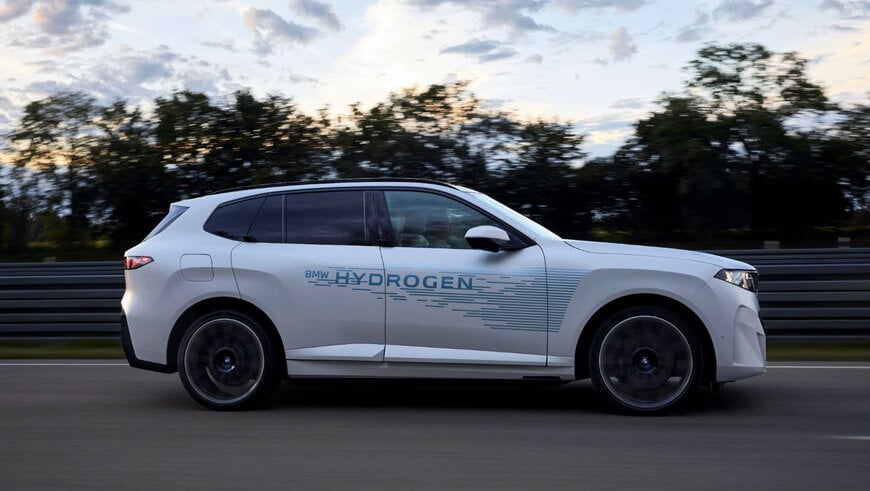
BMW Group is advancing the development of the BMW iX5 Hydrogen towards series production. The project involves the assembly of the fuel cell system at the competence center in Munich and preparations for industrialization at the Steyr plant.
Addressing the Industrial Challenge
The integration of hydrogen propulsion into series-production vehicles requires precise coordination between technical components and industrial production processes. The automotive sector faces the need to combine high driving dynamics with a long range and short refueling times while maintaining zero local emissions.
Technical Architecture and Responsibilities
The BMW iX5 Hydrogen utilizes a third-generation fuel cell system developed in collaboration with Toyota Motor Corporation. The system integrates the fuel cell, an electric motor, a high-voltage battery, the BMW Hydrogen Flat Storage system, and the Energy Master as the central control unit. Inside the cell, hydrogen reacts electrochemically with oxygen from the air to generate electrical current. Josef Hochreiter, Head of Hydrogen Vehicles at BMW Group, stated that ongoing tests demonstrate how the fuel cell system, high-voltage battery, and electric powertrain have already been successfully integrated with a view to series production.
Deployment and Operational Integration
The assembly of fuel cell system prototypes takes place at the hydrogen competence center in Munich. In parallel, the first test benches and production equipment have been installed at the Steyr plant in Austria to initiate industrialization. Additional system components are manufactured at the Landshut plant. Claudia Stephan, Head of Technology Development and Prototype Construction at BMW Group, specified that each assembly phase helps to optimize processes, gain experience, and systematically share this knowledge with the teams in Steyr.
Applications and Use Cases
Fuel cell technology is designed to support individual mobility and complement battery-electric vehicles, particularly in operational contexts that require high versatility and long ranges. The future BMW X5 platform will offer customers diverse propulsion options, including hydrogen technology to expand zero-emission alternatives.
Results and Operational Impact
The vehicle guarantees an expected range of up to 750 kilometers (according to the WLTP cycle) and complete refueling in less than five minutes. The coordinated interaction between the innovative high-voltage battery and the Energy Master central unit enables higher energy recovery capacity, increasing the overall efficiency of the system. Dynamic performance includes a target acceleration of 0 to 100 km/h in under five seconds. The industrial project is supported by 191 million euros in funding from the German federal government under the IPCEI Hy2Move framework, supplemented by an additional 82 million euros from the State of Bavaria.
Edited by Maria Brueva, Induportals editor – adapted by AI.
www.bmwgroup.com
