
www.auto-innovations.net
01
'26
Written on Modified on
Commercial Golf Car Lithium Battery Thermal Safety
Textron E-Z-GO LLC integrates third-generation Samsung SDI lithium battery technology with autonomous safety systems into model-year 2027 E-Z-GO ELiTE vehicles.
www.textron.com
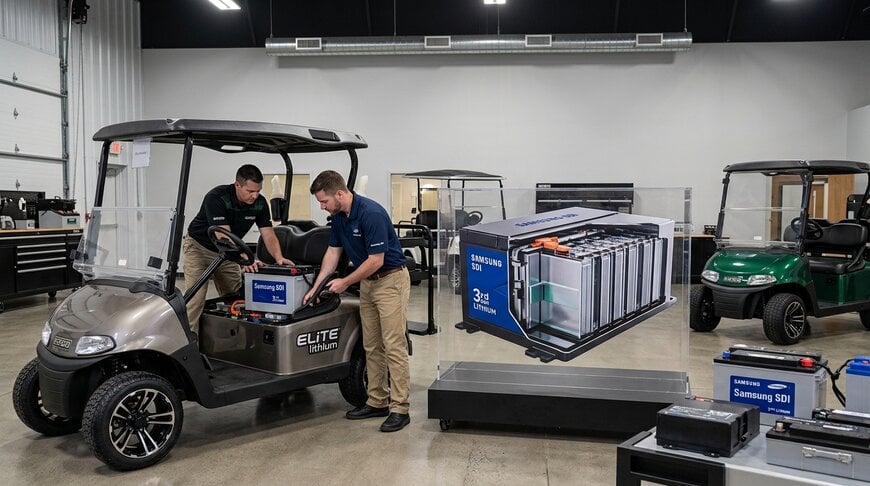
Electrifying commercial fleet utility and low-speed passenger vehicles requires balancing power density and vehicle payload against stringent battery thermal safety and maintenance overhead. In light electric vehicle fleets operated across municipal, recreational, and hospitality venues, energy storage units are exposed to continuous multi-shift cycles, ambient temperature fluctuations, and environmental ingress, requiring multi-layered protection architectures that prevent thermal runaway without adding excessive dead weight.
Operational Challenges in Fleet Electrification
Golf courses and commercial facility operators face ongoing operational challenges with vehicle power packs, including cell degradation, parasitic discharge during extended idle periods, and turf compaction caused by heavy vehicles. Traditional lead-acid battery packs require routine watering, terminal corrosion remediation, and frequent replacement, adding labor costs while increasing total vehicle weight. While lithium-ion chemistries resolve routine maintenance demands and lower lifecycle operating costs, mitigating thermal risk under mechanical shock, moisture exposure, or internal cell failure remains a central engineering priority.
Multi-Layered Battery Management and Safety Architecture
To address these operational and safety requirements, the third-generation power pack developed by Samsung SDI introduces several automotive-grade protection mechanisms focused on fault isolation and continuous diagnostic monitoring.
Central to the electrical architecture is an enhanced battery management system that tracks cell health, voltage levels, and thermal parameters. This system operates periodically even when the vehicle is powered down and disconnected from charging infrastructure, ensuring dormant faults or abnormal self-discharge are identified early. If the internal control logic detects an abnormal operating condition, an automated controlled discharge sequence safely expels stored energy to minimize hazards associated with short-circuits or physical damage.
Internal Cell Potting and Thermal Isolation
At the hardware packaging level, the battery assembly incorporates cell potting, encapsulating individual lithium cells within a dedicated protective compound. This compound acts as a physical and thermal barrier, inhibiting heat transfer from an isolated compromised cell to adjacent cells.
The packaging also integrates internal housing sensors engineered to identify particulate or moisture ingress. When internal contamination exceeds defined parameters, the system triggers a vehicle-level electrical interlock, immobilizing the drive system until inspection and clearance occur. In extreme thermal failure events, a heat-activated suppression mechanism directly releases fire-suppressing agent inside the sealed enclosure. External shielding is reinforced by a redesigned structural battery tray and protective cover to resist mechanical impacts and debris encountered in daily commercial operation.
Fleet Integration and Mechanical Dynamics
Vehicle-level weight reduction provides measurable mechanical benefits in fleet management. The third-generation pack design preserves a compact footprint, allowing model-year 2027 E-Z-GO RXV golf cars to achieve a weight advantage of more than 75 pounds compared to competing fleet golf vehicles. Lower overall mass reduces ground-contact pressure, mitigating turf compaction on maintained fairways and sports turf while lowering tractive energy requirements.
The transition from early commercial lithium platforms to modern configurations reflects cumulative operational refinement. Since introducing ELiTE-series lithium vehicles in 2017, the platform has surpassed 230,000 operational units deployed across more than 3,750 golf facilities globally, accumulating more than 88 million operational field hours without the routine acid balancing and watering intervals demanded by conventional flooded battery installations.
Additional Context
This section details technical specifications and competitive benchmarking not included in the original product announcement.
The commercial light electric vehicle (LEV) sector has increasingly transitioned from flooded lead-acid and absorbed glass mat (AGM) power sources to lithium iron phosphate (LFP) and nickel-manganese-cobalt (NMC) chemistries to meet higher uptime and efficiency standards. In utility and golf fleet operations, lead-acid systems typically impose a dead weight of 130 to 180 kg (285 to 400 lbs), carry lower round-trip coulombic efficiency (approx. 70-80%), and have service lifetimes limited to 500-800 cycles. By comparison, automotive-grade lithium-ion packs maintain round-trip efficiencies exceeding 90% and support cycle lives exceeding 2,000 to 3,500 charge cycles depending on depth of discharge and thermal conditions.
Thermal runaway containment has become a benchmark requirement in LEV safety design, influenced by international standards such as UL 2271 (Standard for Batteries for Use in Light Electric Vehicle Applications) and ISO 12405 (Electrically propelled road vehicles - Test specification for lithium-ion traction battery packs). While standard commercial utility vehicle batteries typically rely solely on external fuse protection and basic high-temperature cutoff algorithms, the integration of structural cell potting compounds and automated internal aerosol or chemical fire suppression systems directly parallels the design practices used in high-voltage passenger electric vehicles and stationary energy storage systems (BESS).
Edited by Evgeny Churilov, Induportals Media - Adapted by AI.
www.textron.com
