
www.auto-innovations.net
04
'26
Written on Modified on
Dürr delivers 20,000th automated painting robot to Ford
The EcoRP4 milestone system utilizes advanced rotary atomizers to reduce material consumption and VOC emissions.
www.durr.com
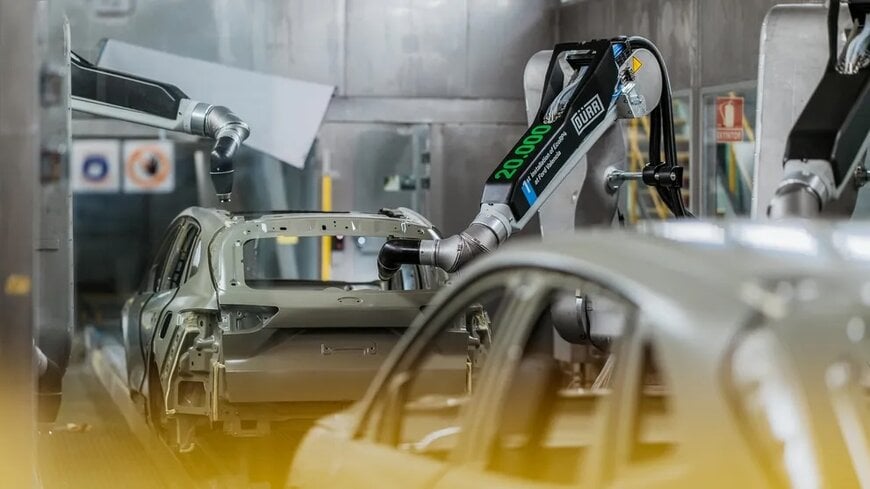
Dürr has marked a significant manufacturing milestone with the delivery of its 20,000th automated painting robot. The milestone unit, an EcoRP4 L033L/R from the company's fourth-generation robotic portfolio, was recently installed at Ford’s vehicle assembly plant in Valencia, Spain. Operating within a newly commissioned primer station on the exterior application line for the Ford Kuga, the robot integrates Dürr’s proven process technology with a highly streamlined mechanical design to optimize large-scale automotive paint operations.
Lifecycle optimization and high-transfer efficiency
Engineered to reduce both operational expenditures and maintenance complexity, the EcoRP4 platform features a simplified mechanical architecture with a reduced component count compared to previous iterations. The robot supports highly flexible kinematics and can be adapted to various paint shop configurations, including floor-mounted, tower, and linear-rail (EcoRail X2/S2) deployments. At the Valencia plant, the robotic arm is paired with the EcoMCC3 A/B color changer and the EcoBell4 Pro 2x1K rotary atomizer. By utilizing Dürr’s High-Transfer-Efficiency (HTE) process, the system actively minimizes paint and rinsing-agent losses, significantly reducing overspray. This precision application not only lowers direct material costs but also drastically curtails the release of volatile organic compounds (VOCs).
Additional Context: Electrostatic rotary bell atomization and transfer efficiency
This section details the fluid dynamics and electrostatic principles of automotive paint application not included in the original press release.
In modern high-volume automotive paint shops, maximizing Transfer Efficiency (TE)—the percentage of dispensed paint that actually adheres to the vehicle body versus being lost as overspray—is critical for cost control and environmental compliance. Systems like the EcoBell4 utilize high-speed rotary bell atomization combined with electrostatic charging to achieve TE rates often exceeding 80% to 90%. Fluid paint is pumped into a titanium or aluminum bell cup spinning at up to 70,000 revolutions per minute (RPM). The extreme centrifugal force drives the paint to the cup's serrated edge, where it is sheared into a fine, highly uniform micron-sized mist. Simultaneously, a high-voltage cascade applies a negative DC charge (typically between -60 kV to -100 kV) to the paint droplets. Because the vehicle body is electrically grounded via the conveyor, the negatively charged paint particles are strongly attracted to the sheet metal through electrostatic forces. This electric field actively pulls the paint droplets along the electrostatic flux lines, literally wrapping the coating around curved edges and into recesses, dramatically reducing the amount of atomized paint that escapes into the downdraft spray booth ventilation system.
Edited by an industrial journalist, Lekshman Ramdas, with AI assistance.
www.durr.com
