
www.auto-innovations.net
13
'26
Written on Modified on
Magneti Marelli expands aftermarket A/C compressor range for 170 million vehicles
The range covers fixed, variable-displacement, CVC and scroll compressors, supporting reliable thermal system repairs across Europe’s independent automotive aftermarket.
www.marelli.com
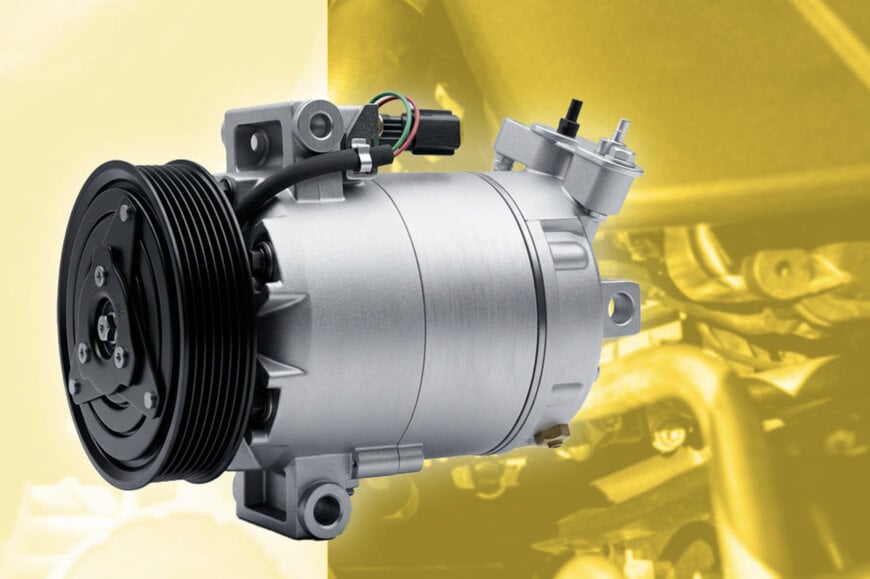
Workshops replacing a failed A/C compressor need a part that matches the original equipment architecture, refrigerant and lubrication requirements of each vehicle. Magneti Marelli Parts & Services has introduced a new range of air conditioning compressors for the independent automotive aftermarket, covering more than 170 million vehicles in the European car parc.
Why the A/C Compressor Determines Air Conditioning System Performance
The compressor is the core component of the vehicle air conditioning system. It raises the pressure and temperature of the refrigerant vapour so that heat absorbed in the cabin can be released at the condenser. Its performance therefore directly affects cooling capacity, overall system efficiency and cabin comfort, and in more advanced systems it also influences vehicle energy consumption. A replacement compressor that does not match the original specification can reduce cooling performance, increase noise or shorten system life. The new range expands the company's Thermal Systems portfolio and is updated in line with changes in the vehicle fleet.
Compressor Architectures: Fixed, Variable Displacement, CVC and Scroll
The range includes the main architectures used in original equipment applications, reflecting the technological evolution of automotive air conditioning:
- Fixed-displacement compressors, which deliver a constant volume per revolution and regulate cooling by cycling the clutch.
- Variable-displacement compressors, which adjust their output to the cooling demand, reducing load on the engine.
- CVC (Continuous Variable Capacity) compressors, which modulate capacity continuously for more stable cabin temperatures.
- Scroll compressors, engineered to help reduce noise levels.
- Each architecture is designed for specific application requirements and refrigerant flow management needs, supporting system efficiency, driving comfort and operational reliability.
Materials and Design Criteria for Long-Term Reliability
During design, the company focuses on cooling capacity, operational efficiency, acoustic comfort, reduction of vibration transmitted to the passenger compartment and long-term reliability. Material selection includes aluminium alloys for scroll components and housings, high-strength alloy steels for drive shafts, premium copper alloys for valve plates and bearing friction surfaces, and high-performance sealing polymers. Materials are validated through bench testing before entering serial production.
Validation Testing and IATF 16949 Production
Production takes place in facilities specialised in A/C compressor manufacturing, certified to the automotive quality management standard IATF 16949 and compliant with the EU REACH regulation on chemical substances. The validation process includes CAE (Computer-Aided Engineering) simulations during design, dimensional inspection of critical components, performance testing across the full speed and pressure range, durability testing and NVH (Noise, Vibration and Harshness) assessments in controlled thermal environments. Artificial intelligence-based systems monitor acoustic anomalies along the production lines, and every unit undergoes refrigerant leak testing. Testing cycles replicate real vehicle operating conditions.
Installation Data, Lubrication and Part Identification
Compressors are supplied pre-filled with oil. However, the company recommends checking the lubricant quantity during installation, as the pre-filled amount may not correspond to the actual requirement of the vehicle's refrigeration circuit. Technical data, including refrigerant type, oil specification and quantity, pulley diameter and number of grooves, is available through TecDoc and the Magneti Marelli Parts & Services WebCat to support accurate identification.
Protective Packaging for Aftermarket Logistics
Each compressor is housed in a custom internal protection system that guards against mechanical impacts and moisture during transport, with additional measures for units containing sensitive electrical components. The outer packaging is the brand's yellow and blue double-wall corrugated cardboard box.
Additional Context:
This section details technical specifications and competitive benchmarking not included in the original product announcement.
The European aftermarket for A/C compressors is shaped by refrigerant regulation and vehicle electrification. Under the EU Mobile Air Conditioning Directive 2006/40/EC, air conditioning systems in all new passenger cars registered from 2017 must use refrigerants with a global warming potential (GWP) below 150. This led to the widespread replacement of R134a (GWP around 1,430) by R1234yf, so the European car parc now contains both refrigerant generations, making correct identification of refrigerant type and oil specification essential. Mechanically driven variable-displacement compressors typically regulate output by changing the swash plate angle, avoiding the temperature fluctuations and load peaks of clutch cycling. Scroll compressors use one fixed and one orbiting spiral to compress refrigerant with fewer moving parts and smoother flow, which lowers noise and vibration. The scroll principle is also the dominant design for electrically driven compressors in hybrid and electric vehicles, where insulating lubricants are required to protect the integrated motor.
Edited by Natania Lyngdoh, Induportals editor, with AI assistance.
www.magnetimarelli-parts-and-services.com
