
www.auto-innovations.net
12
'26
Written on Modified on
FORVIA HELLA Unveils Compact Modular 90 mm LED Lighting Kit
New freeform optical platform cuts weight by seventy percent while delivering higher efficiency and direct halogen replacement for global commercial and special vehicle manufacturers.
www.forvia.com
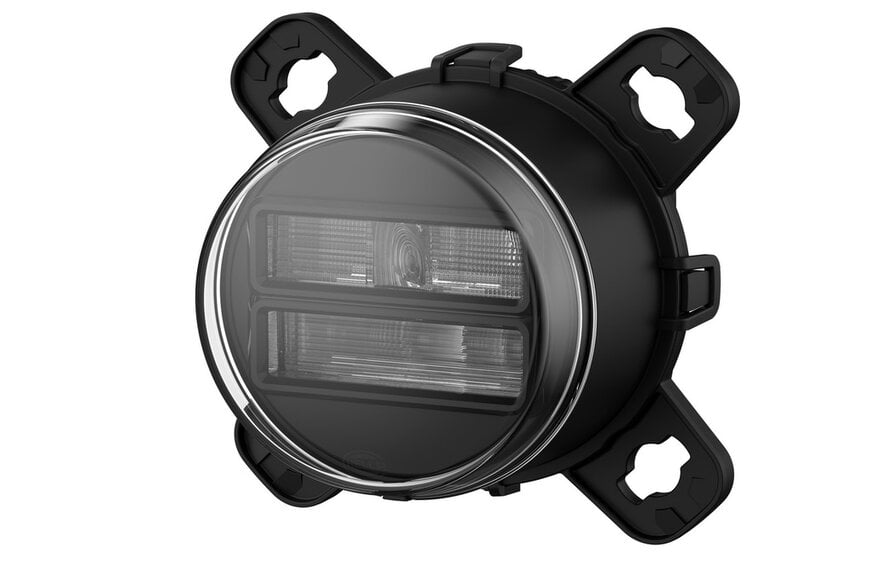
Integrating modern front lighting into agricultural machinery, construction equipment, buses, trucks, light commercial vehicles, and motorhomes presents persistent packaging and engineering challenges. Vehicle front ends must simultaneously accommodate sensor suites, thermal management hardware, and control electronics within tightly constrained spatial envelopes, while legacy platforms often rely on standardized 90 mm halogen apertures that restrict optical upgrades without costly chassis or housing redesigns. To address these integration demands in the commercial vehicle lighting sector, automotive supplier FORVIA HELLA has developed the Lighting Kit, a modular 90 mm front lighting platform scheduled to enter series production in spring 2027.
Engineering Architecture and Freeform Optical Design
Conventional headlamp upgrades often require larger housings or deep rear clearances to manage light distribution and heat dissipation, limiting where engineers can place adjacent components. Building on more than thirty years of 90 mm module development, the Lighting Kit utilizes a newly engineered optical system based on high-precision freeform optics. Unlike traditional reflector geometries that suffer from higher optical losses and bulkier depth requirements, freeform surfaces direct light rays with higher precision to achieve homogeneous road illumination from a minimized aperture.
Compared to its direct predecessor, the FORVIA HELLA Bi-LED Module Generation 3, the new system delivers approximately 50 percent higher optical efficiency. This efficiency gain allows the module to generate high light output while cutting total module weight by 70 percent and reducing installation depth by nearly half. Lower component mass directly decreases raw material consumption, while the shallow rear profile frees up critical installation depth behind the front fascia for radar sensors, cooling ducts, and electronic control units.
Modular Platform Integration for Special Vehicle Manufacturing
Special-purpose and commercial vehicle manufacturers produce relatively low to medium volumes across highly varied body styles, making bespoke headlamp engineering financially and logistically prohibitive. The Lighting Kit addresses this production requirement through a standardized modular platform architecture. Rather than engineering distinct optical assemblies for each vehicle model, original equipment manufacturers can configure multiple front lighting variants — such as a Bi-LED module combining low beam and high beam functions — from a single shared mechanical and optical baseline.
According to Dirk Sossenheimer, who leads the Front & Signal Lighting product line at FORVIA HELLA, the platform transfers the company's optical engineering into the compact 90 mm format to create its smallest LED light module to date. Planned platform expansions will incorporate additional front lighting and signal functions alongside customer-specific outer geometries, enabling manufacturers to adapt styling and functionality without revalidating the core optical engine.
Mechanical Compatibility and Global Regulatory Homologation
Transitioning existing vehicle fleets and ongoing production lines from incandescent halogen bulbs to solid-state LED systems frequently stalls due to mechanical incompatibility and regional certification hurdles. The Lighting Kit is engineered as a direct 1:1 mechanical replacement for established 90 mm halogen modules, retaining identical mounting points and physical interfaces. This drop-in compatibility allows manufacturers to upgrade existing vehicle platforms to LED technology without modifying front-end tooling or mounting brackets.
To support global vehicle distribution without region-specific hardware variants, the platform carries worldwide homologation covering UN (United Nations) regulations for Europe and international markets, SAE (Society of Automotive Engineers) standards for North America, CCC (China Compulsory Certificate) requirements, and Indian automotive lighting regulations.
Additional Context
This section details technical specifications and competitive benchmarking not included in the original product announcement.
The 90 mm circular headlamp format has served as an industry-standard building block in commercial, agricultural, and municipal vehicle manufacturing for decades, standardized across suppliers such as FORVIA HELLA, Valeo, and Bosch to allow flexible front-end styling using common optical inserts. In modern off-highway and commercial vehicles, the shift from 55 W or 65 W H7 and H9 halogen lamps to LED modules is driven by longer operational lifespans under high-vibration duty cycles, lower electrical power draw, and improved color temperature closer to daylight.
While previous-generation 90 mm LED modules successfully replaced halogen light sources, their deep aluminum heat sinks often exceeded the rear clearance of older halogen housings, forcing body builders to modify mounting buckets. By reducing installation depth by roughly 50 percent and weight by 70 percent compared to the Bi-LED Module Generation 3, the Lighting Kit directly targets the mechanical packaging bottleneck that previously prevented drop-in LED retrofits in tight front-end architectures. Furthermore, simultaneous compliance with UN ECE Regulation No. 149 (road illumination devices) and SAE J581/J1383 standards eliminates the need for separate left-hand-drive and regional headlamp part numbers in export-oriented special vehicle production.
Edited by Evgeny Churilov, Induportals Media - Adapted by AI.
www.hella.com
