
Infineon advances centralized automotive radar with 4Tx/4Rx RASIC CTRX8144FS for corner sensing
The 76–81 GHz radar MMIC offers up to 4 GHz bandwidth, 1.2 Gbps CSI-2 data transfer and integrated waveguide ports for ADAS corner sensing.
www.infineon.com
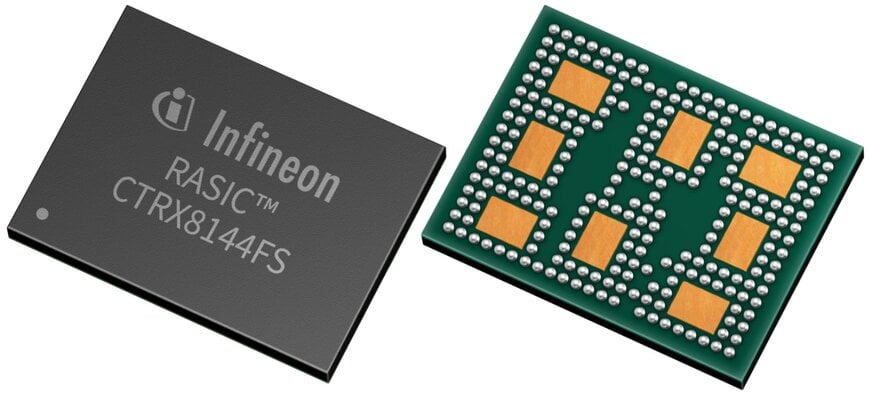
Infineon Technologies AG has introduced the RASIC™ CTRX8144FS, a 76–81 GHz radar monolithic microwave integrated circuit (MMIC) equipped with four transmit and four receive channels (4Tx/4Rx). Building on the CTRX8191F/FS and CTRX8188F, the device further expands Infineon's radar portfolio for centralized vehicle architectures and targets corner and front radar applications in advanced driver assistance systems (ADAS) and software-defined vehicle platforms.
High-resolution corner sensing and raw data streaming
As automotive manufacturers shift from distributed smart sensors toward centralized computing architectures, corner radar underpins safety functions including cross-traffic monitoring, lane merging, skewed intersections, and roundabouts across varying weather, lighting, and visibility conditions. Engineered for high-resolution environmental perception, the CTRX8144FS supports modulation bandwidths of up to 4 GHz and fast frequency ramp slopes of up to 200 MHz/µs for rapid object detection and tracking.
An integrated CSI-2 interface transmits raw radar data at rates of up to 1.2 Gbps per lane directly to a central compute unit. Onboard features—including a digital phase-locked loop (PLL), a flexible ramp sequencer, and integrated power management with low-dropout regulators (LDOs)—support versatile waveform configurations while reducing external bill-of-materials component counts.
Andreas Kopetz, Head of the Radar Product Line at Infineon, explained that centralized processing moves signal processing from the radar sensor into a central ADAS compute unit. By eliminating memory and compute bottlenecks at the sensor level, this architecture accommodates larger radar datasets and more sophisticated algorithms, supporting gains in detection range, sensitivity, and target separation while providing high-fidelity radar data for AI- and machine-learning-based sensor fusion.
Automotive safety qualification and simplified RF integration
Qualified to AEC-Q100 Grade 1 standards and developed as an ISO 26262 Safety Element out of Context (SEooC), the CTRX8144FS supports functional safety requirements up to ASIL B for ADAS deployments. Direct communication with the central compute unit simplifies sensor design and minimises the need for additional companion components.
Integrated radio-frequency (RF) waveguide ports eliminate complex high-frequency transitions on printed circuit boards (PCBs) and minimise signal losses. Low thermal resistance supports stable operation across automotive operating temperatures, supported by integrated diagnostic functions that continuously monitor radio-frequency performance and internal temperatures. The RASIC CTRX8144FS is available now.
Additional Context:
This section explains general principles of satellite radar architectures and launcher-in-package waveguide interfaces in automotive ADAS systems not included in the original press release.
In conventional "smart" edge radar sensors, an integrated microcontroller performs Fast Fourier Transforms (FFTs), Constant False Alarm Rate (CFAR) target detection, and object tracking locally inside the bumper-mounted module, sending only compressed object lists over CAN-FD or 100BASE-T1 Ethernet. By contrast, centralized "satellite" radar heads transmit uncompressed raw analog-to-digital converter (ADC) sample streams over high-speed MIPI CSI-2 links directly to a domain controller, allowing multi-sensor raw data fusion across all four vehicle corners before target thresholding occurs.
At millimetre-wave frequencies between 76 GHz and 81 GHz, routing RF signals across standard PCB laminates introduces substantial dielectric attenuation and requires costly specialty substrates. Integrating waveguide launcher ports directly onto the MMIC package enables electromagnetic waves to couple straight from the silicon transceiver into hollow, metallised plastic waveguide antennas, reducing insertion loss and lowering PCB manufacturing costs.
Edited by an industrial journalist, Lekshman Ramdas, with AI assistance.
